
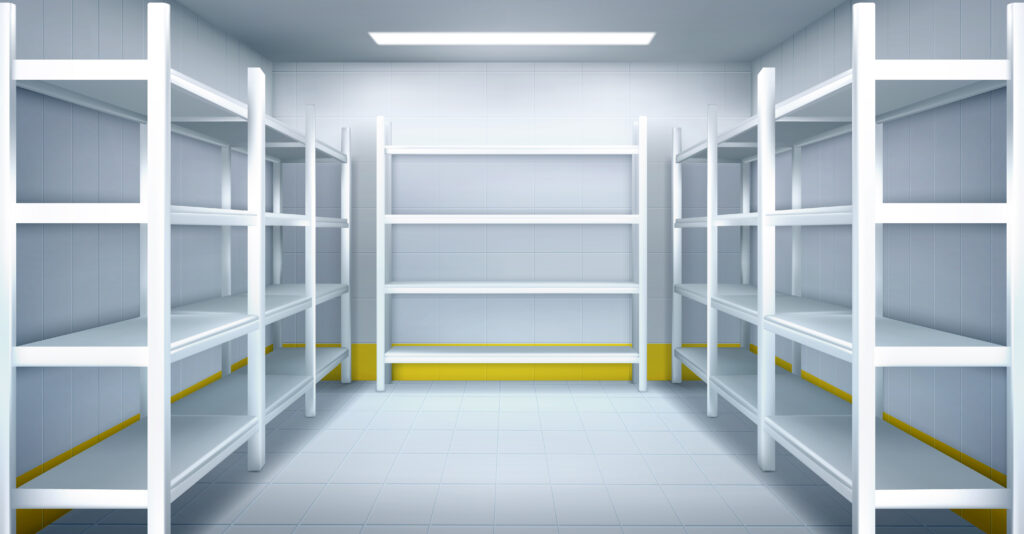
Summary: Cold room racking requires corrosion-resistant materials (galvanised or stainless steel), verified load ratings at low temperatures, and compliance with SANS food-grade hygiene standards. The right system depends on your temperature range, forklift clearance needs, and product type. In South Africa, where cold chain logistics is expanding rapidly, choosing the wrong racking can compromise safety, hygiene, and efficiency.
Why Cold Room Racking Is a Specialist Category
Standard warehouse racking and cold room racking are not interchangeable. Refrigerated environments — whether chilled (0°C–8°C) or deep-frozen (−18°C to −25°C) — place unique stress on structural steel, coatings, and fasteners.
Metal contracts at low temperatures, adhesives weaken, and condensation cycles accelerate corrosion. A racking system that performs reliably in an ambient warehouse can fail prematurely inside a cold store if it wasn’t engineered for those conditions.
For South African food distributors, pharmaceutical cold chains, and agricultural processors, this distinction is critical. Getting it wrong doesn’t just cost money — it creates food safety and worker safety risks.
The Core Engineering Challenges of Cold Storage Racking
1. Corrosion in High-Humidity, Low-Temperature Environments
Cold rooms cycle between warm and cold as doors open, product moves, and defrost cycles run. This creates persistent condensation on racking surfaces — the ideal condition for rust.
Standard powder-coated mild steel is not adequate for sustained cold room use. You need either:
- Hot-dip galvanised steel — a zinc coating applied by immersion, providing robust, long-lasting corrosion protection suitable for most chilled environments
- Stainless steel (304 or 316 grade) — the premium choice for deep-freeze, high-humidity, or food-contact applications requiring full hygiene compliance
2. Load Ratings at Low Temperatures
Steel becomes more brittle at sub-zero temperatures, which affects how load ratings should be interpreted. A beam rated at 1,000 kg in ambient conditions may behave differently under sustained freezer temperatures, particularly under dynamic loading from forklifts.
Always request cold-temperature load certification from your racking supplier — not just standard ambient ratings. Krost Shelving, as an ISO 9001-certified manufacturer with over 50 years of experience in Southern Africa, engineers its systems with these variables in mind.
3. Forklift Clearance in Narrow Refrigerated Aisles
Cold rooms are expensive to build and operate. Every square metre of floor space costs money to refrigerate. This pushes operators toward narrow-aisle configurations — which in turn demands precise racking design.
Forklift mast heights, turning radii, and load overhang must all be calculated against your racking layout before installation. A poorly planned aisle can result in constant upright damage, which in a cold environment is especially dangerous because corrosion accelerates at impact points.
Galvanised vs Stainless Steel: Which Is Right for Your Cold Room?
| Feature | Hot-Dip Galvanised | Stainless Steel (304/316) |
|---|---|---|
| Corrosion resistance | High — suitable for chilled rooms | Very high — ideal for deep-freeze & food-grade |
| Temperature range | 0°C to −18°C (standard) | −25°C and below |
| Hygiene compliance | Good — smooth zinc surface | Excellent — non-porous, easy to sanitise |
| Cost | Lower upfront cost | Higher upfront cost |
| Load capacity | High — comparable to mild steel | High — consistent at sub-zero temps |
| Ideal application | Chilled distribution, beverage storage | Pharmaceutical, meat processing, deep-freeze |
| Maintenance | Inspect annually for coating damage | Minimal — highly durable long-term |
For most South African chilled warehouses operating between 0°C and −10°C, hot-dip galvanised racking offers the best balance of durability and cost. For deep-freeze facilities or environments requiring HACCP compliance, stainless steel cold storage racking is the appropriate choice.
SANS Compliance and Food-Grade Storage in South Africa
South Africa’s food storage sector is governed by the South African National Standard (SANS) 10049 and related food safety regulations aligned with international HACCP principles. For cold room storage racks used in food-grade environments, this means:
- Racking surfaces must be non-porous and cleanable — ruling out untreated mild steel
- No exposed fasteners that can trap food particles or harbour bacteria
- Structural integrity must be maintained under both static and dynamic loads
- Regular racking safety inspections must be conducted and documented
Krost Shelving follows SEMA (Storage Equipment Manufacturers’ Association) guidelines and international safety standards, making their systems well-suited to food-grade cold storage compliance. Their warehouse storage solutions and industrial racking systems are designed with these compliance requirements built in.
Step-by-Step Guide: Selecting Cold Room Racking for Your Facility
Use this process to avoid costly mistakes when specifying cold storage shelving or pallet racking for a refrigerated warehouse.
Step 1: Define your temperature range
Chilled (0°C–8°C), frozen (−10°C to −18°C), or deep-frozen (below −18°C)? This determines your material specification immediately.
Step 2: Identify your product type and weight
Palletised goods, cartons, or loose product? Calculate your maximum unit load weight and confirm this against cold-rated beam capacity.
Step 3: Assess your hygiene classification
Is your facility HACCP-regulated? Do you handle open food product? If yes, stainless steel cold storage racks or fully galvanised systems with sealed fasteners are required.
Step 4: Map your forklift equipment
Measure your forklift’s mast height, load centre, and turning radius. For cold rooms, narrow-aisle reach trucks are common — your racking layout must match the equipment, not the other way around.
Step 5: Calculate your aisle configuration
Work with your racking supplier to model aisle widths, bay depths, and upright spacing. In cold stores, every 100mm of wasted aisle space adds to your refrigeration footprint and operating cost.
Step 6: Plan for racking inspections
Build SEMA-compliant inspection access into your layout from day one. Cold room racking is harder to inspect than ambient racking — don’t design yourself into a corner.
Step 7: Request a site assessment and formal quote
A reputable supplier will conduct a site visit, not just send a price list. Request a quote from Krost Shelving to arrange a professional assessment for your cold storage facility.
Cold Storage Racking System Types: What Works Where
Pallet Racking for Cold Stores
The most common system for large-volume cold storage. Selective pallet racking allows direct access to every pallet — important when stock rotation (FIFO) is critical for perishables.
For deep-freeze environments with high-density storage needs, drive-in racking reduces aisle count and maximises cubic capacity — but it operates on a LIFO basis, which suits single-SKU frozen goods rather than mixed perishables.
Cold Room Shelving for Smaller Facilities
For smaller refrigerated rooms — pharmaceutical dispensaries, catering cold rooms, or retail back-of-house chillers — rivet shelving or bolted steel shelving in galvanised finish is a practical and cost-effective solution.
Krost’s industrial shelving solutions include galvanised options suitable for chilled environments where full pallet racking would be over-specified.
Mezzanine Floors in Cold Stores
Some large cold storage facilities use mezzanine floors to double their vertical storage capacity without expanding the refrigerated footprint. This is a specialist application — the mezzanine structure must be engineered for cold-temperature steel behaviour and the increased load from refrigerated product.
Krost’s industrial mezzanine floor solutions are structurally engineered and can be specified for cold store applications where vertical space optimisation is the priority.
Maintenance and Inspection: The Cold Room Racking Factor
Cold room racking degrades faster than ambient racking — full stop. Corrosion accelerates at impact points, forklift damage is harder to spot under condensation, and low temperatures make steel more susceptible to cracking under repeated stress.
A SEMA-approved racking inspection programme is not optional in a food-grade cold store — it’s a regulatory and insurance requirement. Inspections should check:
- Upright damage from forklift impact (particularly at floor level)
- Beam connector integrity — clips and pins can work loose under vibration
- Coating condition — any breach in galvanising or stainless finish must be addressed immediately to prevent corrosion spread
- Base plate and anchor bolt condition — cold floors with drainage channels are especially corrosive environments
Krost Shelving offers professional racking safety inspections as part of their full-service offering. View the complete range of storage and racking services to understand what’s included in a managed inspection programme.
South Africa’s Cold Chain Growth and What It Means for Racking Demand
South Africa’s cold chain logistics sector is expanding, driven by growth in food retail, pharmaceutical distribution, and agricultural exports. The Cold Chain Association of South Africa (CCASA) has highlighted ongoing investment in refrigerated warehousing capacity across Gauteng, the Western Cape, and KwaZulu-Natal — the three provinces where Krost Shelving maintains branches in Johannesburg (Wadeville), Cape Town, and Durban.
This growth means more facilities are specifying cold storage racking systems for the first time — and many are making avoidable mistakes by applying ambient racking specifications to refrigerated environments.
Krost Shelving has been manufacturing and supplying industrial storage solutions across Southern Africa since 1965. Their ISO 9001 certification, SEMA-aligned inspection services, and in-house manufacturing capability make them a trusted partner for cold chain operators who need systems built to last in demanding refrigerated conditions.
FAQ
Q1: What is the best material for cold room racking in a food-grade facility?
A1: Hot-dip galvanised steel is suitable for most chilled environments (0°C to −18°C). For deep-freeze or HACCP-regulated food-grade facilities, stainless steel (grade 304 or 316) is recommended due to its non-porous surface, ease of sanitation, and superior corrosion resistance at sub-zero temperatures.
Q2: Does cold temperature affect the load rating of racking systems?
A2: Yes. Steel becomes more brittle at sub-zero temperatures, which can affect structural behaviour under dynamic loads. Always request cold-temperature load certification from your supplier, not just ambient load ratings, particularly for deep-freeze pallet racking systems.
Q3: What SANS standards apply to cold room storage racks in South Africa?
A3: SANS 10049 covers food hygiene requirements relevant to cold storage environments. Racking in food-grade facilities must also comply with HACCP principles, which require non-porous, cleanable surfaces and documented structural safety inspections.
Q4: How often should cold room racking be inspected?
A4: SEMA guidelines recommend formal racking inspections at least annually, with regular in-house checks monthly. Cold store racking should be inspected more frequently due to accelerated corrosion risk and the difficulty of spotting forklift damage under condensation.
Q5: Can standard warehouse shelving be used in a cold room?
A5: Standard mild steel shelving with powder-coat finish is not suitable for cold room use — condensation cycles will cause rapid corrosion. Galvanised or stainless steel shelving specifically designed for refrigerated environments must be used to ensure longevity, hygiene compliance, and structural safety.

