
Keypoint Summary
- Selective pallet racking gives direct access to every single pallet position, without needing to move other pallets first.
- It is the most widely used racking system in South Africa, suited to businesses with a wide range of SKUs and frequent picking.
- Beam heights are adjustable, making the system easy to reconfigure as stock changes over time.
- It offers strong value for the accessibility it provides, though it uses floor space less densely than high-density systems like drive-in or shuttle racking.
- Krost Shelving & Racking is one of South Africa and Africa’s leading manufacturers of selective pallet racking, designing and building every system in-house.
If you picture a typical warehouse racking system in your head, there is a good chance you are picturing selective pallet racking. It is the most common type of racking used across South African warehouses, and for good reason. This guide covers what selective pallet racking actually is, how it works, its key benefits, and the situations where it is genuinely the best choice, so you can decide whether it is the right fit for your operation.
What Is Selective Pallet Racking?
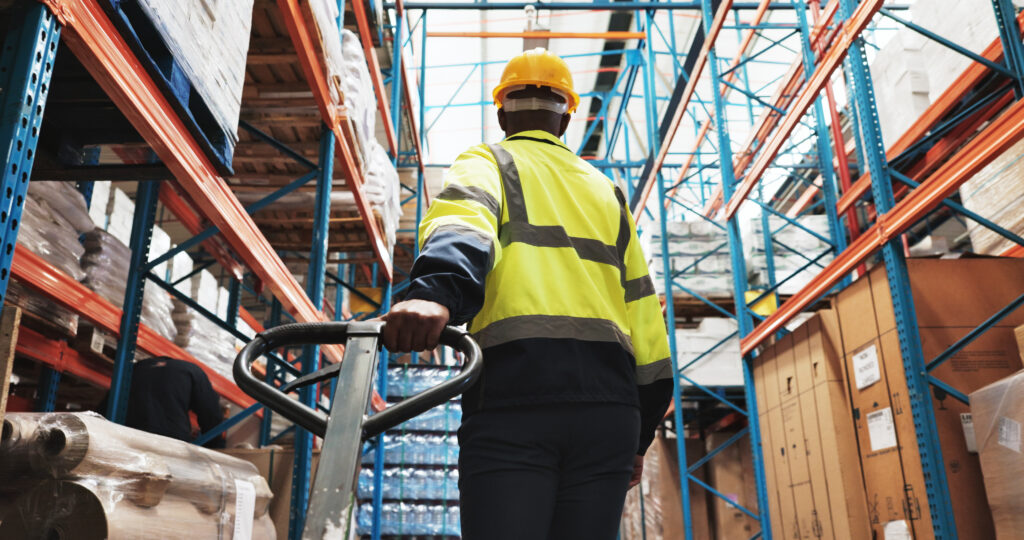
Selective pallet racking is a warehouse storage system built from adjustable upright frames and horizontal beams, arranged into rows of individual pallet positions accessed directly from an aisle. The beams are typically finished in the blue and orange colour scheme that makes them easy for forklift drivers to identify at a glance.
The defining feature of selective pallet racking is exactly what the name suggests: selectivity. Every pallet position can be reached independently, without shifting any other pallet out of the way first. A forklift simply drives down the aisle, lifts the specific pallet needed, and moves on. This is different from higher density systems like drive in racking, where pallets are stacked several deep and accessed in a fixed order.
How Selective Pallet Racking Works
A basic selective pallet racking bay consists of two upright frames connected by pairs of horizontal beams at each level. Pallets sit directly on the beams, one per position, with an aisle running along the front of the system wide enough for a forklift or reach truck to manoeuvre in and lift each pallet.
Because every level and every bay is independently accessible, warehouse staff can pick any pallet at any time without disturbing stock around it. This makes selective pallet racking particularly well suited to operations where different products move at different speeds, since fast-moving and slow-moving stock can sit side by side without one blocking access to the other.
Key Features of Selective Pallet Racking
Full pallet accessibility. Every position is reachable directly, which is the single biggest advantage over higher density racking types.
Adjustable beam heights. Beams can be repositioned up or down the upright frames, so storage levels can be reconfigured as pallet heights or stock profiles change, without needing to replace the structure.
Modular design. Additional bays can be added alongside existing runs as a warehouse grows, making it straightforward to scale the system over time.
Wide compatibility. Selective pallet racking works with standard forklifts and reach trucks, without requiring specialised narrow aisle equipment.
Straightforward installation and maintenance. Compared to more complex systems like pallet shuttle or VNA racking, selective pallet racking is generally quicker to install and simpler to maintain.
Benefits of Selective Pallet Racking
Fast, flexible picking. Since every pallet is directly accessible, order picking and stock replenishment tend to be faster and simpler than with high density alternatives.
Ideal for a wide product range. Warehouses storing many different SKUs benefit from being able to access any product at any time, rather than being locked into a fixed loading and unloading order.
Efficient stock rotation. Selective racking makes it easy to manage stock rotation manually, since staff can access any pallet directly rather than being restricted to a last in first out or first in first out sequence.
Cost effective for most operations. While it is not the most space efficient system per square metre, its simplicity, flexibility, and lower installation complexity often make it the most cost effective choice for general warehousing.
Easy to expand or reconfigure. As stock volumes or product ranges change, bays can be added, removed, or adjusted with relatively little disruption.
Best Uses for Selective Pallet Racking
Selective pallet racking suits a wide range of industries and operations, but it tends to be the strongest fit in a few specific situations.
Businesses with many different SKUs. Retail distribution, wholesale, and general warehousing operations that stock a wide variety of products benefit most from full pallet accessibility.
Operations with frequent order picking. Where orders are picked regularly and need quick turnaround, direct access to every pallet reduces picking time compared to high density systems.
Warehouses with moderate throughput. Selective racking suits businesses that need reliable, everyday access to stock rather than extremely high volume, single SKU storage, where a denser system like drive in or pallet shuttle racking might make more sense.
Facilities planning to grow or change over time. Because the system is modular and beam heights are adjustable, selective pallet racking adapts well to a business whose stock profile is likely to shift.
It is worth noting that selective pallet racking is not necessarily the right choice for every operation. Businesses storing very large volumes of a small number of SKUs, or operating in space-constrained facilities where maximising density matters more than individual pallet access, may be better served by drive-in racking, pallet shuttle racking, or VNA racking instead.
Choosing the Right Selective Pallet Racking System
Even within selective pallet racking, the right specification depends on your actual stock and space. Beam length and depth need to match your pallet sizes, upright frame height needs to suit your building’s clearance, and load ratings need to be specified correctly for the weight you are storing. Getting any of these wrong can mean wasted space, awkward handling, or a system that is not rated for the loads it is actually carrying.
This is where working with an established manufacturer matters. Krost Shelving & Racking is one of South Africa and Africa’s leading manufacturers of selective pallet racking and other storage systems, designing and building every system in-house rather than reselling a generic product. That means beam lengths, frame heights, and load ratings can be specified precisely around your warehouse and stock, rather than fitted to an off-the-shelf template.
Frequently Asked Questions
Is selective pallet racking the same as standard pallet racking?
Yes, selective pallet racking is generally what people mean when they refer to standard pallet racking. It is the most common and widely recognised racking type in South African warehouses.
How much weight can selective pallet racking hold?
Load capacity varies depending on the specification, including beam length, frame height, and upright thickness. A properly designed system should be specified and load rated for your actual stock, rather than assumed from a generic figure.
Is selective pallet racking suitable for cold storage?
Yes, selective pallet racking can be used in cold storage environments, though the specific finish and design considerations may differ slightly to account for temperature and moisture.
Can selective pallet racking be reconfigured later?
Yes. Beam heights can be adjusted up or down the upright frames, and bays can be added or removed, making it one of the more flexible racking types to adapt over time.
How is selective pallet racking different from drive-in racking?
Selective pallet racking gives direct access to every pallet position individually. Drive-in racking stacks pallets several deep and accesses them in a fixed order, trading accessibility for higher storage density.
Does Krost manufacture selective pallet racking in-house?
Yes. Krost Shelving & Racking designs, manufactures, and installs selective pallet racking in-house, along with the full range of other racking types, shelving, and mezzanine floors.
Final Thoughts
Selective pallet racking earns its place as the most widely used racking system in South Africa because it strikes a practical balance between accessibility, flexibility, and cost. For most general warehousing operations, it remains the sensible default, and for businesses with more specific density or throughput needs, understanding its strengths and limits helps clarify whether a different racking type might serve better.
For a full breakdown of every racking type and how to choose between them, see our complete guide to racking systems. You can also view our Selective Pallet Racking range directly, or get in touch with our team for a free site assessment and a system specified around your actual stock and space.

