
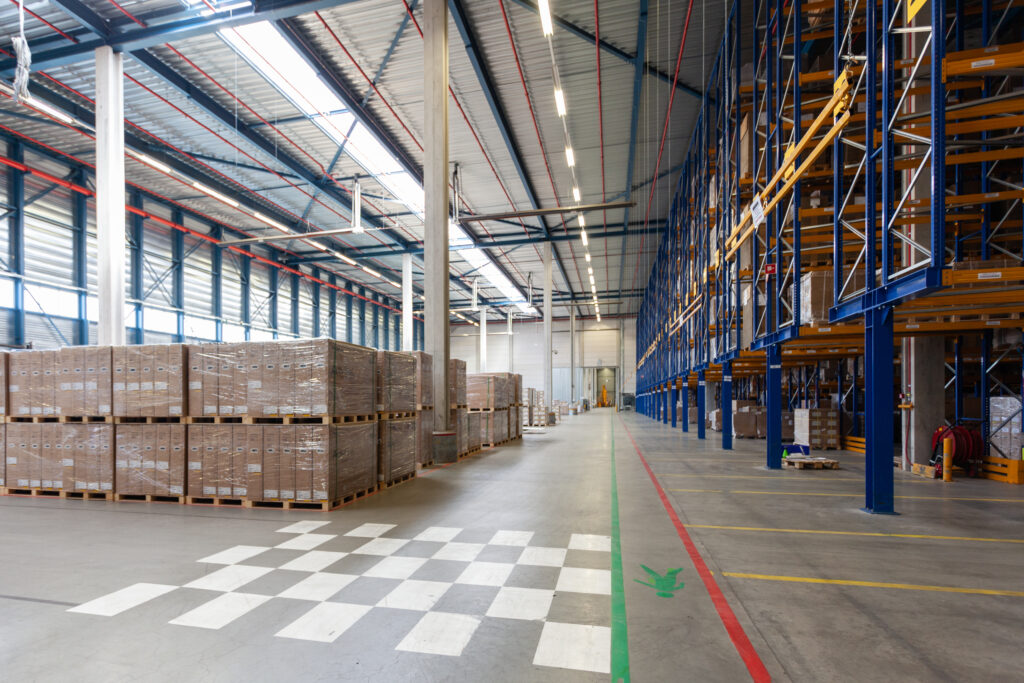
South Africa’s logistics and warehousing sector has grown steadily, with the country’s cold-chain, retail, and manufacturing industries all demanding smarter vertical storage. When floor space in Gauteng, Cape Town, or Durban costs what it does today, maximising cubic metres — not just square metres — is a financial necessity.
Pallet racking is the most efficient way to achieve that. It allows forklifts to stack palletised goods multiple levels high, turning a modest footprint into a high-capacity distribution hub.
This guide is written from the perspective of Krost Shelving and Racking’s six decades of manufacturing experience. It walks warehouse managers, logistics decision-makers, and procurement teams through every factor that matters before signing a purchase order.
The Main Types of Pallet Racking Available in South Africa
Not all racking systems are equal. The right choice depends on your product mix, pallet weight, throughput speed, and available floor area.
Selective Pallet Racking
Selective racking is the most widely used system in South African warehouses. Every pallet is directly accessible from the aisle — no other pallets need to be moved first.
- Best for: High SKU variety, FIFO inventory management, operations where individual pallet access is frequent.
- Typical aisle width: 2.5 m to 3.5 m for counterbalance forklifts; narrower aisles possible with reach trucks.
- Load capacity: Typically 800 kg to 3 500 kg per pallet position, depending on beam and upright specification.
Drive-In and Drive-Through Racking
Drive-in racking eliminates most of the aisle space by allowing forklifts to enter the racking structure itself. Pallets are stored on rails, depth-wise, rather than side-by-side.
- Drive-in: Single entry point. LIFO (last in, first out). Ideal for bulk, low-SKU storage.
- Drive-through: Entry from both ends. Supports FIFO rotation. Common in cold stores and food distribution.
- Best for: Frozen goods, seasonal stock, commodities stored in large quantities of the same SKU.
- Space efficiency: Up to 85% floor utilisation compared to roughly 40–50% for selective racking (Source: SEMA, 2023).
Push-Back Racking
Push-back racking uses inclined rails and nested carts. When a new pallet is loaded, it pushes the existing pallet back. When one is removed, the row rolls forward.
- Depth range: Typically 2 to 6 pallets deep.
- Best for: Operations needing higher density than selective racking but requiring more SKU variety than drive-in allows.
Cantilever Racking
Cantilever racking has no front column, making it ideal for long or awkward items — steel pipes, timber, extrusions, or furniture.
It is a staple in South African manufacturing plants and building-materials wholesalers. Krost manufactures cantilever systems in both light-duty and heavy-duty configurations.
Narrow-Aisle and Very Narrow Aisle (VNA) Racking
VNA racking reduces aisle widths to as little as 1.6 m, requiring specialist guided forklifts. It is a premium investment but delivers maximum storage density in high-value urban warehouse space — particularly relevant in Johannesburg’s industrial nodes like Wadeville, Isando, and Kempton Park.
Pallet Racking Load Capacity: What the Numbers Mean
Load capacity is the single most misunderstood specification in racking procurement. There are three separate figures buyers must understand:
| Specification | Definition | Why It Matters |
| UDL (Uniformly Distributed Load) | Maximum load per shelf beam pair | Determines beam size and spacing |
| Bay Load | Total load per bay (all levels combined) | Determines upright and floor anchor spec |
| Point Load | Load applied at a single contact point | Critical for pallets with uneven weight distribution |
| Seismic/Dynamic Load | Additional forces from forklift impact or vibration | Relevant to SANS 10160 in South Africa |
Rule of thumb: Never load a racking system beyond the rated capacity displayed on the load notice placard. South African regulations, aligned with SEMA guidelines, require a load notice to be visible on every racking bay.
Overloading is one of the leading causes of racking collapse in South African warehouses. A single collapse can cause fatalities, destroy stock worth millions of rands, and trigger regulatory shutdowns.
SEMA Safety Standards and South African Compliance
SEMA (Storage Equipment Manufacturers’ Association) guidelines are the international benchmark adopted widely across South Africa’s industrial sector. Krost Shelving designs and manufactures to SEMA standards, as well as SANS (South African National Standards) structural codes.
Key Compliance Requirements for South African Warehouses
- Load notices must be posted on every racking bay, displaying maximum bay load and beam UDL.
- Floor anchoring — uprights must be bolted to the concrete floor according to engineer-approved anchor specifications.
- Column guards and end protectors must be installed wherever forklifts operate near racking.
- Regular inspections — SEMA recommends a formal racking inspection at least once per year, plus an internal walk-around inspection weekly.
- Damage reporting — any upright or beam showing visible damage must be taken out of service immediately and assessed before reloading.
Krost Shelving offers SEMA-approved racking inspections conducted by trained assessors. This is particularly important for warehouses that have experienced forklift incidents or that have not had a formal inspection in over 12 months. Explore Krost’s [full range of warehouse storage and safety services](https://www.krostshelving.com/services/) to see how inspection and maintenance fit into a complete storage lifecycle.
Step-by-Step: How to Plan a Pallet Racking Installation in South Africa
Whether you are fitting out a new warehouse in Durban’s Bayhead precinct or reconfiguring a Johannesburg distribution centre, the planning process follows the same sequence.
Step 1 — Conduct a site survey
Measure the building’s internal clear height, column grid, floor flatness (FM2 or FM1 tolerance matters for VNA), and door/dock positions. Note any sprinkler systems, as racking height affects fire suppression zoning.
Step 2 — Define your pallet profile
Record pallet dimensions (standard South African pallet: 1 200 mm × 1 000 mm), maximum pallet weight, and the heaviest SKUs. This determines beam UDL requirements.
Step 3 — Map your inventory
Categorise SKUs by turnover velocity (A, B, C). Fast-moving A-lines need direct access (selective racking). Slow-moving C-lines are candidates for drive-in or push-back density storage.
Step 4 — Choose your racking type
Use the comparison table in the previous section as your starting matrix. Involve your forklift supplier — aisle width and lift height are interdependent decisions.
Step 5 — Request a structural design and layout drawing
A reputable South African racking manufacturer will provide CAD layout drawings and, for larger installations, a structural engineer’s sign-off. This is non-negotiable for insurance and compliance purposes.
Step 6 — Obtain a quote with full specification
Insist on a quote that lists upright height, upright gauge (mm), beam length, beam UDL rating, and the number of levels. Comparing quotes on price alone without matching specifications is a common and costly mistake.
Step 7 — Installation and commissioning
Professional installation teams should anchor uprights, level frames, and install column guards. Upon completion, load notices must be fitted and a handover inspection completed.
Step 8 — Schedule ongoing inspections
Book your first annual SEMA-approved inspection and set up an internal weekly walk-around checklist. View Krost’s completed warehouse and racking projects to see how this process looks across different industries and building types.
Total Cost of Ownership: Beyond the Purchase Price
South African procurement teams often focus on the capital cost of racking. The smarter calculation is total cost of ownership (TCO) over a 10–15 year lifespan.
TCO Components to Factor In
1. Initial capital cost
Upright and beam steel, fabrication, delivery, and installation. Prices fluctuate with local steel input costs — South African manufacturers like Krost have an advantage here, sourcing locally and manufacturing in-house.
2. Installation and commissioning
Professional installation is not optional for heavy-duty systems. Poorly installed racking voids manufacturer warranties and creates liability exposure.
3. Annual inspection and maintenance
Budget for at least one formal SEMA inspection per year and replacement of damaged components. Proactive replacement of a R800 upright protector is far cheaper than a racking collapse claim.
4. Reconfiguration costs
Modular racking can be reconfigured as your business changes. This is a genuine long-term saving versus fixed shelving or mezzanine structures.
5. Downtime risk
A racking failure that shuts down a distribution centre for 48 hours can cost more than the entire racking system was worth. Safety investment is operational risk management.
Approximate Cost Benchmarks (South Africa, 2025)
Note: These are indicative ranges only. Actual pricing depends on steel gauge, height, load rating, and site conditions. Request a formal quote for accurate figures.
| System Type | Indicative Cost Range (per pallet position) | Relative Density |
| Selective Pallet Racking | R850 – R1 800 | Medium |
| Drive-In Racking | R1 200 – R2 400 | High |
| Push-Back Racking | R2 000 – R4 500 | High |
| Narrow-Aisle Racking | R1 500 – R3 200 | Very High |
| Cantilever Racking | Priced per arm/column | Varies |
Mezzanine Floors: The Complement to Pallet Racking
Many South African warehouses combine pallet racking at ground level with a structural mezzanine floor above pick-and-pack or office areas. This approach doubles usable floor space without extending the building footprint — a compelling ROI in high-rent industrial parks in Johannesburg, Cape Town, or Durban.
Mezzanine floors can be designed to integrate directly with racking systems, with staircases, handrails, and pallet gates all engineered as part of the same structure.
Choosing a Pallet Racking Supplier in South Africa: What to Look For
South Africa has several racking suppliers. Here is what separates a credible manufacturer from a reseller or importer.
| Criteria | What to Ask |
| Manufacturing capability | Do they fabricate in South Africa, or import and rebadge? |
| Certifications | ISO 9001? SEMA-aligned design standards? |
| Engineering support | Can they provide structural drawings and engineer sign-off? |
| Installation team | Is installation done by in-house staff or subcontracted? |
| Inspection services | Do they offer post-installation SEMA-approved inspections? |
| References and projects | Can they show completed installations in your industry? |
| Warranty | What is covered, for how long, and under what conditions? |
Krost Shelving has manufactured racking and shelving in South Africa since 1965. The company is ISO 9001-2000 certified, operates from its Wadeville (Johannesburg) manufacturing facility, and has branches in Cape Town and Durban to serve clients across Southern Africa. Every project includes site assessment, design, manufacturing, installation, and post-installation inspection — a genuinely end-to-end service that standalone importers cannot match.
Getting Started with Pallet Racking for Your South African Warehouse
If you are ready to move from research to action, the next step is a site assessment and formal quotation. Krost Shelving’s team covers Johannesburg, Cape Town, Durban, and the broader Southern African region.
A detailed quote costs nothing and gives you a specification document you can use to compare suppliers accurately — not just on price, but on steel gauge, load ratings, and compliance credentials.
Request a pallet racking quote from Krost Shelving and a consultant will be in touch to arrange a site visit or discuss your requirements remotely.
You can also explore the full range of industrial shelving and storage solutions for operations that need a mix of pallet racking and lighter shelving systems.
This guide was produced by the Krost Shelving and Racking content team, drawing on over 60 years of manufacturing and installation experience across Southern Africa. Krost is an ISO 9001-2000 certified manufacturer headquartered in Wadeville, Johannesburg, with branches in Cape Town and Durban.
Frequently Asked Questions: Pallet Racking South Africa
What is the standard pallet size used in South African warehouses?
The most common pallet in South Africa measures 1 200 mm × 1 000 mm, with a standard height of 144 mm. Some operations use Euro pallets (1 200 mm × 800 mm). Your racking beam length and bay width must be specified to match the pallet footprint in use at your facility.
Is pallet racking in South Africa required to meet any specific safety standard?
South African warehouses are expected to comply with SEMA (Storage Equipment Manufacturers’ Association) guidelines and relevant SANS structural codes. Load notices are legally required on every bay, and annual formal inspections are strongly recommended. Krost Shelving designs and inspects to these standards.
How long does a pallet racking installation take in South Africa?
A standard selective racking installation for a mid-sized warehouse (1 000–3 000 pallet positions) typically takes 5–15 working days, depending on site readiness and system complexity. Larger or more complex systems — including drive-in or push-back — may take longer. Your supplier should provide a project timeline before work begins.
Can pallet racking be reconfigured or expanded later?
Yes. Most pallet racking systems — particularly selective and push-back — are modular by design. Beam heights can be adjusted, bays can be added, and uprights can be extended (within their rated capacity) as your storage needs grow. This flexibility is one of the key advantages of steel racking over fixed concrete or timber structures.
What causes pallet racking to fail in South African warehouses?
The most common causes are forklift impact damage to uprights (particularly at the base), overloading beyond the rated UDL, improper installation (inadequate floor anchoring), and failure to replace damaged components promptly. Regular SEMA-approved inspections and a clear internal damage-reporting protocol significantly reduce collapse risk.

