
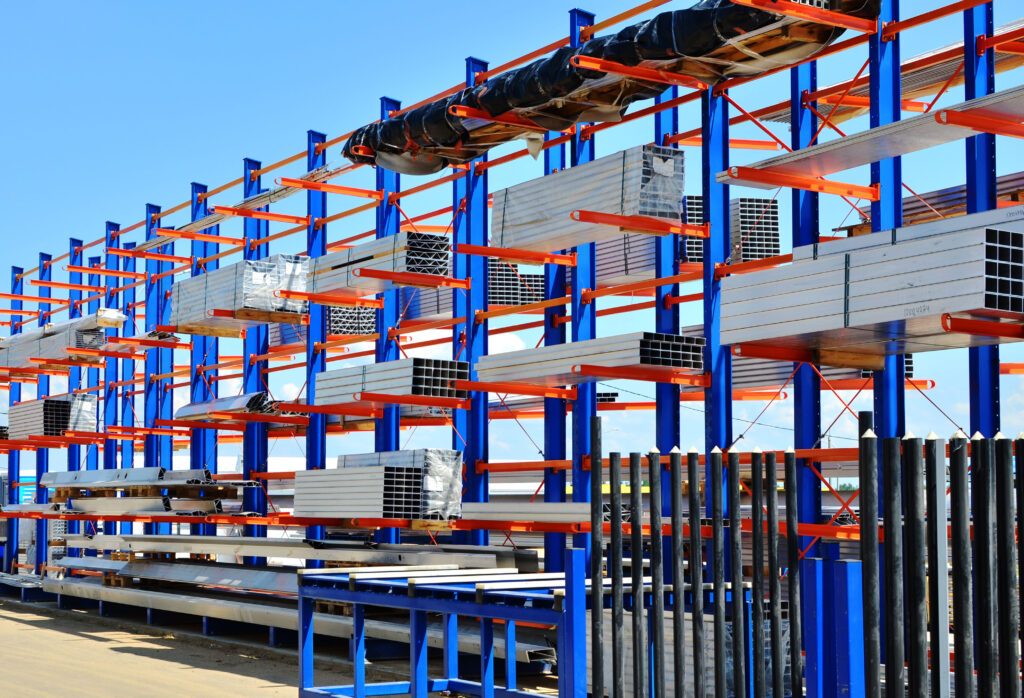
Keypoint Summary
- Cantilever racking uses horizontal arms projecting from a central column, giving completely unobstructed access for loading and unloading long or bulky items.
- It is purpose built for materials that do not fit conventional pallet racking, including timber, steel bars, pipes, coils, and plasterboard.
- The open arm design means there are no upright frames in the way, which makes handling long loads with a forklift or crane far simpler and safer.
- Arm length, spacing, and column height can all be specified to match the exact materials being stored.
- Krost Shelving & Racking is one of South Africa and Africa’s leading manufacturers of cantilever racking, designing and building every system in house.
Some materials simply do not fit on a standard pallet. Timber lengths, steel bars, pipes, and rolled goods are too long, too awkward, or too heavy to sit neatly between the upright frames of conventional pallet racking. That is exactly the problem cantilever racking solves. This guide covers what cantilever racking is, how it works, its key benefits, and the industries and materials it suits best.
What Is Cantilever Racking?
Cantilever racking is a racking system built around a central vertical column, with horizontal arms extending outward at set intervals to create open storage levels. Unlike selective pallet racking or longspan racking, which rely on paired upright frames that box in the storage bay, cantilever racking has nothing in front of or between the arms. This open structure is what gives the system its name and its defining advantage.
Because there are no front uprights to work around, materials can be loaded and unloaded from either side, along the full length of the arms, without needing to line items up between fixed frame positions. That makes cantilever racking especially well suited to items that are long, heavy, or awkward to manoeuvre.
How Cantilever Racking Works
Each cantilever racking unit is made up of a base, a vertical column bolted or braced to the floor, and a series of arms mounted along the column at different heights. The arms support the load directly, with nothing obstructing the front or sides of the storage bay.
Columns and arms can be specified in different lengths and load capacities depending on what is being stored. Longer arms suit longer materials like timber or pipes, while heavier duty columns and arms are used for denser loads like steel bar or coil. Single sided cantilever racking is common where the system sits against a wall, while double sided units, with arms extending from both sides of the column, are used to maximise storage in the middle of a warehouse or yard.
Key Features of Cantilever Racking
Unobstructed loading. With no front uprights, forklifts and cranes can approach from either side and load along the full length of the arm, rather than being restricted to a fixed bay opening.
Adjustable arm heights. Arms can typically be repositioned along the column, allowing storage levels to be reconfigured as material sizes or stock profiles change.
High load capacity per arm. Cantilever racking is engineered to carry substantial point loads, making it suitable for dense materials like steel that would overload standard racking arms.
Single or double sided configurations. Systems can be built against a wall or as a freestanding double sided unit, depending on available space and layout.
Outdoor and indoor use. Cantilever racking is commonly used both inside warehouses and outdoors in yards, with finishes and coatings available for exposed environments.
Benefits of Cantilever Racking
Handles what other racking cannot. Long, bulky, or irregularly shaped items that do not fit safely on a pallet or between standard upright frames are exactly what cantilever racking is designed for.
Faster loading and unloading. Open access from either side means materials can be placed or removed quickly, without manoeuvring around fixed frame positions.
Reduced product damage. Because materials are fully supported along their length rather than balanced awkwardly on a pallet, the risk of bending, denting, or dropping long items is significantly reduced.
Efficient use of space. Arm spacing and column height can be tailored precisely to the materials being stored, avoiding wasted vertical space that often comes with trying to fit long items onto standard racking.
Built for heavy, repeated handling. Cantilever racking is engineered for the kind of frequent, high load handling common in steel, timber, and building materials environments.
Best Uses for Cantilever Racking
Cantilever racking is a staple in industries dealing with long or bulky raw materials and finished goods. Common applications include:
Steel and metal fabrication. Bar stock, tube, pipe, and sheet metal all suit cantilever storage, where dense, heavy materials need secure, accessible storage.
Timber and building materials. Lengths of timber, plasterboard, and similar construction materials are among the most common cantilever racking applications.
Furniture manufacturing. Long components and finished pieces that do not fit standard pallet dimensions often move through cantilever storage during production.
Plumbing and piping supply. Pipes and conduit of varying lengths and diameters are well suited to the open, adjustable arm structure.
General industrial and yard storage. Any operation storing long, rigid, or coiled materials outdoors or in a warehouse can generally benefit from cantilever racking over conventional alternatives.
If your business regularly struggles to store long or awkward materials safely, or finds standard pallet racking leaves length hanging out over the aisle, cantilever racking is very likely the right fit.
Choosing the Right Cantilever Racking System
The right cantilever racking specification depends on the materials being stored. Arm length needs to match the longest items you handle, arm spacing needs to suit the diameter or bundle size of the load, and column height and load rating need to be specified for both the weight per arm and the total column load. Getting any of these wrong can mean overhang, instability, or a system that is not rated for what it is actually carrying.
This is where working with an established manufacturer matters. Krost Shelving & Racking is one of South Africa and Africa’s leading manufacturers of cantilever racking, designing and building every system in house rather than reselling a generic product. That means arm lengths, column heights, and load ratings can be specified precisely around your materials, rather than fitted to an off the shelf template.
Frequently Asked Questions
What is the main advantage of cantilever racking over pallet racking?
Cantilever racking has no front uprights, so long or bulky items can be loaded and unloaded from either side without being restricted by fixed frame positions, unlike standard pallet racking.
What materials is cantilever racking best suited for?
Long, bulky, or irregularly shaped materials such as timber, steel bar, pipe, plasterboard, and coiled goods are typical cantilever racking applications.
Can cantilever racking be used outdoors?
Yes. Cantilever racking is commonly used in outdoor yards as well as indoors, with appropriate finishes and coatings available for exposed environments.
Is cantilever racking single sided or double sided?
Both configurations exist. Single sided units are typically placed against a wall, while double sided units have arms extending from both sides of the column and are used to maximise storage in open floor areas.
How much weight can cantilever racking arms hold?
Load capacity depends on the specification, including arm length, column strength, and bracing. A properly designed system should be specified and load rated for your actual materials rather than assumed from a generic figure.
Does Krost manufacture cantilever racking in house?
Yes. Krost Shelving & Racking designs, manufactures, and installs cantilever racking in house, along with the full range of other racking types, shelving, and mezzanine floors.
Final Thoughts
Cantilever racking exists to solve a problem that conventional pallet racking simply cannot: storing long, bulky, or awkward materials safely and accessibly. For steel, timber, piping, and similar industries, it is often the only racking type that genuinely fits the job.
For a full breakdown of every racking type and how to choose between them, see our complete guide to racking systems. You can also view our Cantilever Racking range directly, or get in touch with our team for a free site assessment and a system specified around your materials and space.

