
Keypoint Summary
- Racking is a structural steel storage system for palletised and bulk goods, built to make full use of a warehouse’s height, not just its floor space.
- Racking is a category, not a single product. Common types include selective pallet, longspan, drive in, VNA, pallet shuttle, cantilever, carton live, and catwalk racking.
- Racking differs from shelving mainly in load and handling. Racking suits heavier, forklift handled pallets, while shelving suits lighter, hand loaded goods.
- Choosing the right system depends on what you store, how fast it moves, your available space, and the equipment you use to load and unload it.
- Krost Shelving & Racking is one of South Africa and Africa’s leading racking manufacturers, designing, building, and installing every system in house.
If you’re new to warehousing, logistics, or industrial storage, you’ve probably heard the word “racking” thrown around a lot, but it’s not always obvious what it actually means, or why there seem to be so many different kinds of it. This guide breaks it down in plain terms: what racking is, why businesses use it, the main types you’ll come across, and how it’s different from shelving.
What Is Racking?
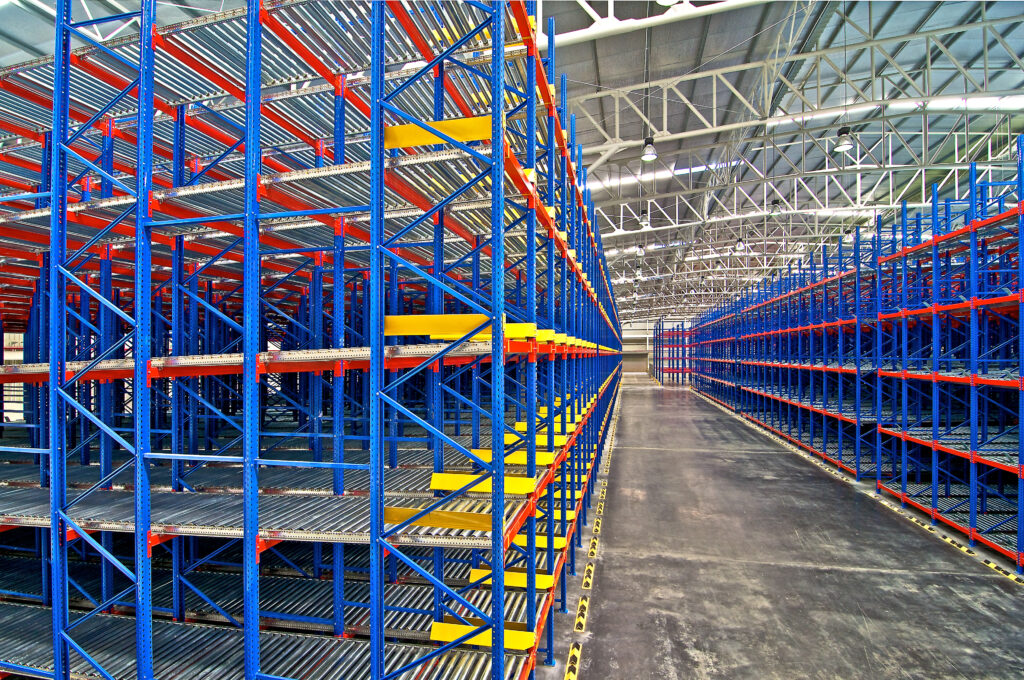
Racking is a structural steel storage system used to store goods, usually on pallets, in an organised, stacked arrangement, typically in a warehouse, distribution centre, or industrial facility. Think of it as a robust storage framework that lets a business store products several levels high, making full use of a building’s height rather than just its floor space.
A basic racking system is made up of a few simple parts: tall steel upright frames that anchor into the floor, and horizontal beams that connect between them to create each storage level. Pallets, boxes, or bulky items then sit on those beams, and forklifts or other equipment are used to load and unload them.
It’s worth pointing out early on that racking isn’t one single product. It’s a category. There are several different types of racking systems, each designed for a different combination of load, space, and how quickly stock needs to move. We’ll get into those shortly.
Why Do Businesses Use Racking?
At its core, racking solves a simple problem: how do you store as much stock as possible, as safely and efficiently as possible, in the space you have?
It makes use of vertical space. Most warehouses have far more height available than they use. Racking lets a business build storage upward, which is usually a much cheaper way to add capacity than moving to a bigger building.
It keeps stock organised and easy to find. Rather than stacking pallets loosely on the floor, racking gives every item a defined position, which makes it faster to locate stock, count inventory, and fulfil orders.
It protects products from damage. Pallets stacked directly on top of each other risk crushing whatever is underneath. Racking supports each level independently, so the weight of upper pallets never rests on the goods below.
It improves safety. A properly designed and installed racking system, loaded within its rated capacity, is far safer than ad hoc floor stacking, for both staff and stock.
It supports growth. Most racking systems are modular. As a business grows or its stock changes, racking can usually be reconfigured, extended, or adjusted rather than replaced entirely.
The Main Types of Racking
This is where things can get a little overwhelming for beginners, because there isn’t just one type of racking. There are several, each suited to different needs. Here’s a simple overview of the main ones you’ll come across in South African warehouses:
Selective pallet racking is the most common type. Every pallet has its own position and can be accessed directly, without needing to move anything else out of the way first. It’s a good general purpose option for businesses with a wide range of products.
Longspan racking uses wider beams for bulkier or irregularly shaped items that don’t sit neatly on a standard pallet, things like cartons, spare parts, or archive boxes.
Drive in racking allows a forklift to drive directly into the racking structure, stacking pallets several deep. It fits a lot of stock into a small footprint, but you trade off individual pallet access for that density.
VNA (very narrow aisle) racking uses narrower aisles than standard racking, which means more storage fits into the same floor area, usually paired with specialised forklifts designed to operate in tight spaces.
Pallet shuttle racking uses a remote controlled shuttle to move pallets automatically within deep storage lanes, which is ideal for businesses storing large volumes of the same product.
Cantilever racking is designed for long or awkward items, like timber, pipes, or steel, using arms that stick out from a central column instead of an enclosed frame, so there’s nothing in the way when loading or unloading.
Carton live (flow) racking uses gravity to move stock automatically from the loading side to the picking side, which keeps older stock moving out first, useful for products with expiry dates or where stock rotation matters.
Catwalk / pick face racking combines bulk pallet storage up top with a walkable picking level below, so staff can pick individual items by hand while bulk stock is stored above them.
Each of these exists because different businesses have different needs. A furniture warehouse, a cold storage facility, and a spare parts distributor are unlikely to need the same racking setup, even though they’re all technically storing stock on racking.
Is Racking the Same as Shelving?
Not quite, and it’s a common point of confusion for people new to the industry. Racking is generally built for heavier, palletised loads that are handled with a forklift. Think full pallets of stock in a warehouse. Shelving, on the other hand, is designed for lighter items loaded by hand. Think a retail stockroom, a parts counter, or an archive room. Many businesses actually use both: racking for bulk pallet storage, and shelving for smaller, more frequently accessed items.
How Do You Know Which Racking System You Need?
There’s no single “correct” racking system. It depends on a few key factors:
- What you’re storing (palletised goods, bulky items, long materials, etc.)
- How much of it you’re storing, and how fast it moves
- Whether you need to access every item individually, or just bulk stock
- How much floor space and building height you have available
- What equipment (forklifts, reach trucks) you’re using to load and unload
Because these factors interact with each other, the right answer usually comes from a proper site assessment rather than guesswork, someone experienced looking at your actual stock, space, and workflow, and recommending a system built around that. This is where working with an established manufacturer makes a real difference. Krost Shelving & Racking is one of South Africa and Africa’s leading manufacturers of racking, shelving, and custom storage solutions, designing and building every system in house rather than reselling someone else’s product, which means the system you get is genuinely built around your space and stock.
Racking Common Questions
Do I need racking if I only have a small warehouse?
Yes, arguably even more so. Racking makes the biggest difference in smaller spaces, since it lets you use the height of a small warehouse rather than only its floor area, often unlocking far more capacity than moving to a bigger building would.
Can racking be installed in an existing building, or does it need to be built in from the start?
Racking can almost always be installed in an existing warehouse. It’s a freestanding steel structure that’s fitted to your building rather than built as part of it, which is one of the reasons it’s such a flexible way to add storage capacity.
Is racking a once off purchase, or does it need ongoing attention?
Both. Racking is a long term structural investment, but like any structure carrying heavy loads, it should be checked periodically for damage. A knocked upright or overloaded beam can weaken the whole system over time. Regular inspections are a standard part of keeping any racking system safe.
What’s the difference between buying racking from a manufacturer versus a supplier?
A manufacturer designs and builds the racking system itself, while a supplier typically resells a system made by someone else. Buying from a manufacturer generally means the system can be tailored more precisely to your space and stock, with more accountability if anything needs adjusting down the line. Krost Shelving & Racking is one of South Africa and Africa’s leading racking manufacturers, so every system is designed, built, and installed in house.
How long does it typically take to install a racking system?
It depends on the size and type of system, but a straightforward selective pallet racking installation in an existing warehouse can often be completed within a few days to a couple of weeks. Larger or more complex systems, like VNA or pallet shuttle racking, generally take longer due to the additional design and equipment considerations involved.
Does racking need to be inspected once it’s installed?
Yes. Racking should be checked regularly for damage from forklift collisions, overloading, or general wear, since even small issues can affect structural integrity over time. In South Africa, this is typically guided by SEMA and SARI standards, with a certified inspector reviewing the system periodically.
Getting Started
If you’re just starting to think about racking for your business, the most important thing to understand is that “racking” isn’t a single product. It’s a category of solutions, each built for a different job. Getting the right one in place makes a real difference to how efficiently your warehouse runs, how safely your stock is stored, and how much room you actually have to grow.
For a deeper look at every racking type, how to choose between them, and what to consider around cost and safety compliance, see our complete guide to racking systems. You can also browse our full range of racking systems to see what’s available, or get in touch with our team for a free site assessment and a system recommended for your specific space and stock.

