
Keypoint Summary
- Racking is a heavy-duty, forklift-handled storage system built for palletised and bulk goods — different from lighter, hand-loaded shelving.
- There are 8 main racking types — selective pallet, longspan, VNA, pallet shuttle, catwalk/pick-face, drive-in, carton live/flow, and cantilever — each suited to a different mix of load, space, and stock turnover.
- The right system depends on load type, storage density vs accessibility, stock rotation needs, picking frequency, available space, and equipment.
- Racking safety in South Africa is governed by SEMA/SARI standards, with regular certified inspections essential to prevent structural failure.
- Krost Shelving & Racking is one of Africa’s leading racking manufacturers, designing, manufacturing, installing and inspecting every system in-house since 1965.
Whether you’re planning a new distribution centre, expanding a retail stockroom, or trying to squeeze more capacity out of an existing warehouse, the racking system you choose will shape how efficiently your business stores, moves, and picks stock for years to come. Yet “racking” is a broad term that covers a surprising range of systems, each engineered for a different combination of load, space, and workflow.
This guide brings all of it together in one place. We’ll explain what racking is, walk through every major type of racking system available in South Africa, cover how to choose the right one, and explain the safety standards that should govern any racking installation. As one of Africa’s leading manufacturers of shelving, racking, mezzanine floors, and custom storage solutions, Krost Shelving & Racking has spent nearly 60 years designing, manufacturing, and installing these systems for warehouses, retailers, and industrial facilities across the continent — so we’ve built this guide from decades of hands-on experience, not just theory.
What Is Racking?
Racking refers to structural steel storage systems designed to hold palletised or bulk goods in an organised, vertical arrangement — typically in a warehouse, distribution centre, or industrial facility. Unlike shelving, which is generally used for lighter, hand-loaded goods, racking is engineered to carry heavy loads, often handled with forklifts, reach trucks, or automated equipment, and to make full use of a building’s vertical height rather than just its floor space.
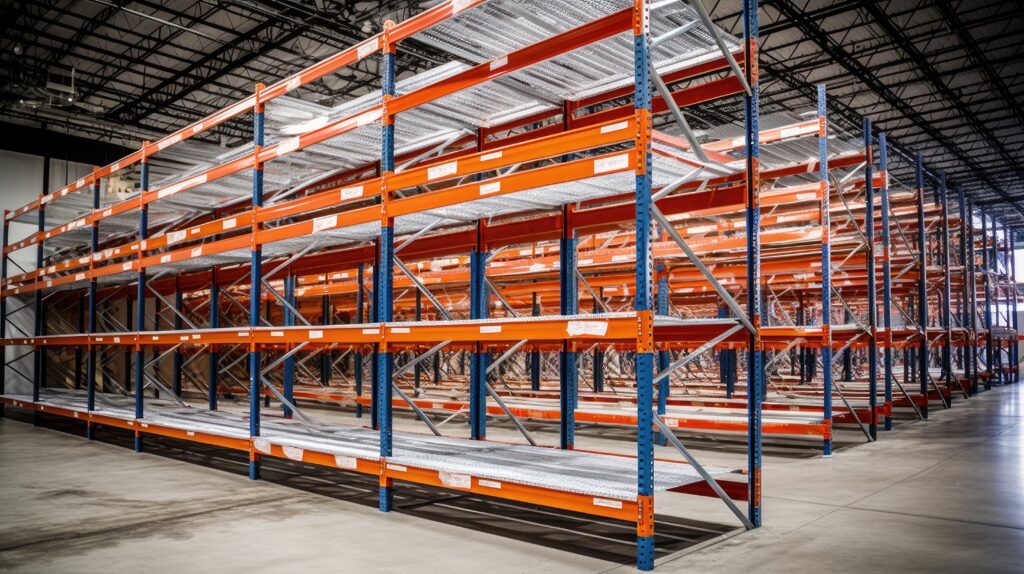
A racking system is made up of a few core components: upright frames (the vertical steel columns), horizontal beams that create the storage levels, and often additional elements like decking, safety barriers, and load-rated accessories. How these components are configured — the spacing between frames, the depth of the bays, the number of levels — determines what type of racking system you end up with, and what it’s suited for.
Getting this right matters. The correct racking system can increase usable storage capacity by 30% or more within the same floor area, speed up picking and dispatch, reduce product damage, and — critically — keep your warehouse compliant and safe. The wrong system, or one that’s poorly designed for your actual stock and workflow, creates bottlenecks, wastes space, and can become a genuine safety hazard.
Why Racking Matters for Your Business
Before looking at the different types, it’s worth understanding what a well-designed racking system actually delivers:
Space optimisation. Most warehouses have far more vertical space than they use. Racking lets you build storage upward instead of only outward, which is often the cheapest way to add capacity — no new building required.
Stock accessibility and picking speed. Different racking types offer different trade-offs between storage density and the speed at which you can access individual pallets or SKUs. Getting this balance right directly affects the speed of order fulfilment.
Product protection. Properly specified racking, installed to the correct load ratings, protects stock from damage caused by overloading, poor stacking, or forklift collisions.
Compliance and safety. Racking failures are a leading cause of warehouse accidents in South Africa, almost always traced back to incorrect installation, overloading, or a lack of regular inspection. A compliant system, installed and inspected to SEMA/SARI standards, protects your staff, your stock, and your business.
Scalability. Most racking systems are modular, meaning you can expand, reconfigure, or add to them as your business grows, without starting from scratch.
Types of Racking Systems
Below are the main racking systems used across South African warehouses and industrial facilities today, each engineered for a different combination of load type, stock turnover, and available space.
Selective Pallet Racking
Selective pallet racking is the most widely used racking system in South Africa, and for good reason — it gives direct, individual access to every single pallet in the system, without needing to move other pallets out of the way first. It’s built from adjustable upright frames and horizontal beams, typically finished in the blue-and-orange colour scheme that makes beams easy for forklift drivers to identify.
Because every pallet position is independently accessible, selective pallet racking suits businesses with a wide range of SKUs and frequent order picking — retail distribution, FMCG, wholesale, and general warehousing. It’s also one of the most cost-effective and flexible systems, since beam heights can be adjusted as your stock profile changes. Read our full guide to Selective Pallet Racking.
Longspan Racking
Longspan racking uses wider, longer beams than standard pallet racking, creating deeper shelf spans that suit bulkier, irregularly shaped, or hand-loaded items rather than uniform palletised stock. It’s a popular choice for archive storage, spare parts, tyres, cartons, and general industrial stock that doesn’t fit neatly onto a standard pallet. Like selective racking, it offers full access to every level, and it’s easily reconfigured as storage needs change. View our Longspan Racking range.
VNA (Very Narrow Aisle) Racking
VNA racking is designed for warehouses where floor space is at a premium. By reducing aisle widths to the minimum needed for specialised narrow-aisle forklifts or automated guided vehicles to operate, VNA systems can significantly increase pallet storage density within the same footprint compared to standard selective racking. It’s a strong option for businesses looking to expand storage capacity without expanding their building. Learn more about VNA Racking.
Pallet Shuttle Racking
Pallet shuttle racking is a semi-automated, high-density storage system that uses a remote-controlled shuttle to move pallets within deep storage lanes, removing the need for forklifts to enter the racking structure itself. This dramatically increases both storage density and picking speed for businesses handling large volumes of the same SKU — think cold storage, food and beverage, or high-throughput distribution centres. It’s one of the more advanced racking solutions available, and demand for it in South Africa is growing quickly as businesses look to automate parts of their warehouse operation. Explore Pallet Shuttle Racking.
Catwalk / Pick-Face Racking
Catwalk, or pick-face, racking combines bulk pallet storage on the upper levels with an accessible, walk-on picking level below — often with mezzanine-style flooring and stairs — allowing staff to pick individual items or cartons at ground level while bulk stock is replenished from above. This hybrid approach is ideal for operations that need both high-volume storage and efficient, manual order picking in the same footprint, such as e-commerce fulfilment and retail distribution. See our Catwalk / Pick-Face Racking systems.
Drive-In Racking
Drive-in (and drive-thru) racking allows forklifts to drive directly into the racking structure to load and unload pallets, stacking them several deep along continuous rails rather than in individual bays. This creates very high storage density, at the cost of individual pallet accessibility — it works on a last-in-first-out (drive-in) or first-in-first-out (drive-thru) basis, so it’s best suited to bulk storage of a limited number of SKUs, such as raw materials or seasonal stock. Discover Drive-In Racking.
Carton Live / Flow Racking
Carton live racking, also known as flow racking, uses gravity and angled roller or wheel tracks to move cartons or pallets automatically from the loading side through to the picking side, ensuring strict first-in-first-out (FIFO) stock rotation without any manual intervention. It’s widely used in FMCG, pharmaceuticals, food and beverage, and any operation where stock rotation and picking speed are critical. Because loading and picking happen from opposite sides, it also removes the congestion that comes with staff and forklifts working the same aisle. Find out more about Carton Live / Flow Racking.
Cantilever Racking
Cantilever racking is purpose-built for long, bulky, or awkwardly shaped loads that don’t fit conventional pallet racking — think timber, steel bars, pipes, coils, plasterboard, and similar materials. Instead of vertical frames obstructing the storage area, cantilever racking uses horizontal arms projecting from a central column, giving completely unobstructed access for loading and unloading with a forklift or crane. It’s a staple in steel, timber, and building materials industries. Browse our Cantilever Racking systems.
Racking vs Shelving: Which Do You Need?
It’s a common point of confusion, so it’s worth a brief clarification here: racking and shelving both provide structured storage, but they’re engineered for different jobs. Racking is designed for heavier, palletised, forklift-handled loads, and is typically the right choice for warehouses and distribution environments. Shelving is designed for lighter, hand-loaded goods — think retail stockrooms, archives, and parts stores — and comes in configurations like bolted, rivet, gondola, mobile, and warehouse shelving. Many facilities use both, with racking handling bulk pallet storage and shelving handling smaller, frequently accessed items. If you’re not sure which applies to your operation, our team can assess your stock and space and recommend the right combination.
How to Choose the Right Racking System
There’s no single “best” racking system — the right choice depends on several factors specific to your operation:
- Load type and weight. Palletised goods, bulky irregular items, and long materials each suit different racking types, as outlined above.
- Storage density vs accessibility. High-density systems like drive-in or shuttle racking store more per square metre but sacrifice individual pallet access; selective racking gives full access but is less space-efficient.
- Stock rotation requirements. If FIFO stock rotation is critical (as in food, pharmaceuticals, or perishables), flow racking or drive-thru systems are usually the right fit.
- Picking frequency and method. Operations with frequent, mixed-SKU picking generally need more accessible systems like selective or catwalk/pick-face racking.
- Available floor space and building height. Narrow-aisle and high-rise configurations can unlock significant capacity in space-constrained sites.
- Forklift and equipment type. Aisle widths and racking depth need to match the turning circle and lift height of your equipment.
- Budget and future growth. Modular systems that can be reconfigured or extended as your business grows tend to offer better long-term value than a system sized only for today’s needs.
This is exactly why a proper site assessment matters. As a manufacturer rather than a reseller, Krost designs racking systems around your actual stock profile, warehouse layout, and equipment — not a generic template.
Racking Safety and Compliance in South Africa
Racking carries significant weight, often several metres above head height, so safety and compliance aren’t optional extras — they’re fundamental to any installation. In South Africa, racking systems should be designed, installed, and maintained in line with SEMA (Storage Equipment Manufacturers Association) and SARI (SEMA Approved Rack Inspector) standards, which govern everything from structural design and load capacity labelling to ongoing inspection intervals.
Regular racking inspections are essential because damage accumulates over time — a forklift collision, an overloaded beam, or corrosion can all compromise structural integrity long before a system visibly fails. A qualified SEMA/SARI inspector can identify this kind of damage before it becomes a safety incident, and recommend repairs or component replacement where needed.
Krost Shelving & Racking is ISO 9001:2015 compliant and has a certified on-site SEMA/SARI inspector, meaning every system we design and install meets strict international safety and compliance standards — and our racking inspection service is available to businesses even where we didn’t supply the original system.
Industries We Serve
Because racking needs vary so much by sector, Krost designs and manufactures systems for more than 20 industries across Africa, including manufacturing, logistics and distribution, retail, healthcare, education, government, food and beverage, automotive, and general warehousing. Whether it’s a single-site stockroom or a multi-branch distribution network, our team works across the full spectrum of racking requirements — from a straightforward selective pallet racking installation through to fully customised, high-density storage solutions.
Why Choose Krost for Your Racking System
There’s an important distinction between racking suppliers and racking manufacturers, and it’s one worth understanding before you buy. A supplier resells systems designed and built by someone else. Krost Shelving & Racking, by contrast, is one of Africa’s leading manufacturers of racking, shelving, mezzanine floors, and custom storage solutions — meaning we design, manufacture, install, deliver, and inspect every system in-house, using high-grade steel and advanced engineering technologies. That end-to-end control lets us tailor systems precisely to your load requirements and space, rather than fitting your warehouse to a standard off-the-shelf product.
A few things that set Krost apart:
- Established in 1965 — nearly 60 years of proven experience designing and manufacturing racking systems across Africa.
- A leading African manufacturer, not just a reseller — every system is designed and built in-house, giving full control over quality, lead times, and customisation.
- ISO 9001:2015 compliant, with a certified on-site SEMA/SARI inspector ensuring every installation meets international safety standards.
- Full-service delivery — from initial site assessment and space planning through to manufacturing, installation, and ongoing inspection support.
- Nationwide reach, with branches serving Johannesburg, Pretoria, Cape Town, Durban, and beyond.
- Experience across 20+ industries, from retail and logistics to manufacturing and healthcare.
The Racking Installation Process
Every Krost racking project follows the same structured process, regardless of size:
- Site assessment. Our team visits your site to understand your stock profile, available space, building constraints, and equipment.
- Design and specification. Based on that assessment, we design a racking layout and specify the correct racking type, load ratings, and configuration.
- Manufacturing. As a manufacturer, we produce your racking system in-house, from high-grade steel, to your exact specification.
- Installation. Our own installation teams — not third-party subcontractors — install the system to SEMA/SARI standards.
- Inspection and sign-off. A certified SEMA/SARI inspector reviews the completed installation to confirm it meets compliance standards.
- Ongoing support. We offer scheduled racking inspections and support after installation, so your system stays safe and compliant as it ages.
Frequently Asked Questions
What is the difference between racking and shelving?
Racking is designed for heavier, palletised, forklift-handled loads and is typically used in warehouses and distribution centres. Shelving is designed for lighter, hand-loaded goods and is more common in retail stockrooms, archives, and parts stores.
Which racking system stores the most stock in the smallest space?
High-density systems like drive-in racking, VNA racking, and pallet shuttle racking generally offer the highest storage density, though each comes with trade-offs in terms of individual pallet accessibility.
How often should racking be inspected in South Africa?
SEMA/SARI guidelines recommend regular formal inspections, typically at least annually, alongside routine internal checks by warehouse staff. Facilities with heavier forklift traffic or higher-risk stock may need more frequent inspections.
Can racking be customised for unusual or oversized items?
Yes. Cantilever racking is specifically designed for long, bulky, or irregularly shaped loads, and Krost also designs fully custom storage solutions for businesses with non-standard requirements.
Is it better to buy racking from a manufacturer or a supplier?
A manufacturer, like Krost, controls the entire process — design, manufacturing, installation, and inspection — which generally means better quality control, more accurate customisation, and more accountability if something needs to be adjusted down the line.
Ready to Optimise Your Storage?
Choosing the right racking system is one of the highest-impact decisions you can make for your warehouse’s efficiency, safety, and long-term capacity. As one of Africa’s leading racking manufacturers, Krost Shelving & Racking brings nearly 60 years of design, manufacturing, and installation experience to every project — backed by ISO 9001:2015 compliance and a certified on-site SEMA/SARI inspector.
Contact our team today for a free site assessment and a tailored racking quote, or explore our full range of racking systems to find the right solution for your space, your stock, and your budget.

